Part 2: How to Repair and Rebuild After Conflict from Couples Counselling Calgary Therapists
What Makes a Healthy Relationship? Our Couples Counselling Calgary AB Therapists Weigh In
Healthy relationships aren’t defined by the absence of conflict—they’re defined by how couples navigate those conflicts, reconnect afterward, and continue building trust. A strong, resilient relationship is grounded in emotional safety, open communication, shared values, and the ability to move through life’s challenges as a team according to our couples counselling Calgary AB therapists.
Healthy relationships include:
Mutual respect and empathy
Honest and compassionate communication
Shared responsibility for emotional well-being
A willingness to apologize, reflect, and grow
Contrary to popular belief, healthy couples do argue. They misunderstand each other. They sometimes hurt each other’s feelings. But what sets them apart is that they know how to repair and rebuild after inevitable moments of rupture. This makes conflict repair an essential healthy relationship tool and one that our couples counselling therapists bring into couples and individual relationship therapy on a regular basis.
The Biggest Conflicts That Come Up in Relationships According to Couples Counselling Calgary AB Therapists
Every couple faces unique struggles, but most conflicts fall into common themes that are seen everyday in couples counselling:
Communication Breakdowns
Misunderstandings, raised voices, or shutting down completely can create recurring patterns of frustration. Misinterpreting a tone or statement, whether in person or via text, can lead to intense conflict or simmering distance for days at a time that can erode relationship intimacy.Differences in Emotional Needs
One partner might need closeness during stress, while the other needs space—leading to misinterpretation and friction. Each partner brings their unique attachment style, personality type, background, and relational experiences into relationships which all inform what we need emotionally and how we cope with happiness, sadness, overwhelm, frustration, grief, shame, and stress.Money and Finances
Anyone else think that this is probably the main source of conflict in relationships? Our couples counselling Calgary AB therapists would agree and see this come up often for couples, though the money friction often has an underlying theme of communication breakdowns and differences in emotional needs that haven’t been addressed and these show up in the realm of money. Spending habits, financial goals, or income differences often trigger deep vulnerability and conflict and can awaken rooted patterns and issues that can surface intensely.Household Responsibilities
When chores or mental load feel uneven, resentment and burnout can grow. This can include distribution of who does what, financial contribution, parenting and caregiving responsibilities, and rest time. Our couples counselling Calgary AB therapists have heard many stories of people feeling resentful while cleaning while their partner sits and relaxes. This might even be an experience that you’ve had as it’s a very common one.Intimacy and Connection
Changes in affection, sexual needs, or emotional closeness can create feelings of rejection or insecurity. These feelings can lead people to pull away and initiate less intimacy which creates greater distance over time.Unresolved Past Issues
Old hurts—whether from earlier in the relationship, past relationships, or childhood trauma or experiences—can re-emerge during conflict.
Conflicts themselves aren’t the real problem, though they can seem to be because they are emotionally driven and upsetting; it’s how couples manage them that determines whether they grow closer or drift apart.
What Is “Repair” in Relationships? Our Couples Counselling Calgary AB Therapists Explore
Repair is the process of reconnecting after conflict, emotional distance, or a rupture in trust. It’s the way partners say, “We may not be perfect, but we’re committed to finding our way back to each other.” It is the way that we can demonstrate care, security, and connection even when there is difficulty happening. It is a powerful relationship tool, probably the most important in our couples counselling Calgary AB therapist’s opinion, as, no matter what we do, there will inevitably be conflict and hurt in relationships (and that’s okay).
Here is more about what repair is, according to our couples counselling Calgary AB therapists. Repair involves:
Acknowledging what happened
Taking responsibility and accountability for one’s part in what happened/is happening
Offering meaningful apologies (not just saying sorry with no accountability or willingness to change)
Actively listening to each other’s perspectives and feelings while seeking to understand, not necessarily agree
Rebuilding emotional safety by turning towards each other rather than away
Re-establishing closeness and understanding while creating a softening in the connection
Think of repair as the glue that strengthens the relationship each time it's tested. When done well, repair not only fixes the damage—it deepens intimacy and reinforces the bond. Another way to think about repair, according to our couples counselling Calgary AB therapists, is like an accordion. During conflict, we move away from our partner and feel the impact of that distance. Repair is the softening that brings us closer to the middle and each other again, allowing the relationship to continue and even strengthen from what has happened.
What Gets in the Way of Repair? Our Couples Counselling Calgary AB Therapists Share
Even couples who love each other deeply may struggle with conflict and repair. Common obstacles to initiating and receiving repair attempts from partners, according to our couples counselling Calgary therapists, include:
Pride and Defensiveness
When partners feel attacked or criticized, they may defend themselves instead of listening or apologizing as this attacks their ego and sense of pride. Here are some tips for moving away from pride towards humility and a more secure ego state.Unregulated Emotions
Anger, shame, or fear can shut down the ability to empathize, making connection harder. Want to work on building your emotional intelligence? Download this free ebook to help you on your journey.Avoidance or Withdrawal
Some people cope with conflict by shutting down, minimizing issues, or avoiding hard conversations. Sometimes this pattern is indicative of your attachment style. Learn if you are securely attached and what secure attachment is here.Difficulty Taking Accountability
Admitting fault can be uncomfortable, especially if someone fears blame or rejection. Here is some advice for lessening your fear of rejection and building confidence.Past Hurts That Haven’t Healed
Old wounds can make current conflicts feel bigger and harder to move past. Wonder if your past trauma(s) are holding you back? Here are some of the top signs that you might benefit from trauma counselling to help you and your relationships.Lack of Skills or Models for Healthy Repair
Many people simply never learned how to apologize, express vulnerability, or move through conflict safely. Our couples counselling Calgary AB therapists see many couples learning these skills for the first time in therapy and self-educating themselves on what they never learned.
Repair requires vulnerability—and vulnerability is most difficult when emotions are running high.
Tips for Healthy Repair (With Examples) From Couples Counselling Calgary AB Therapists
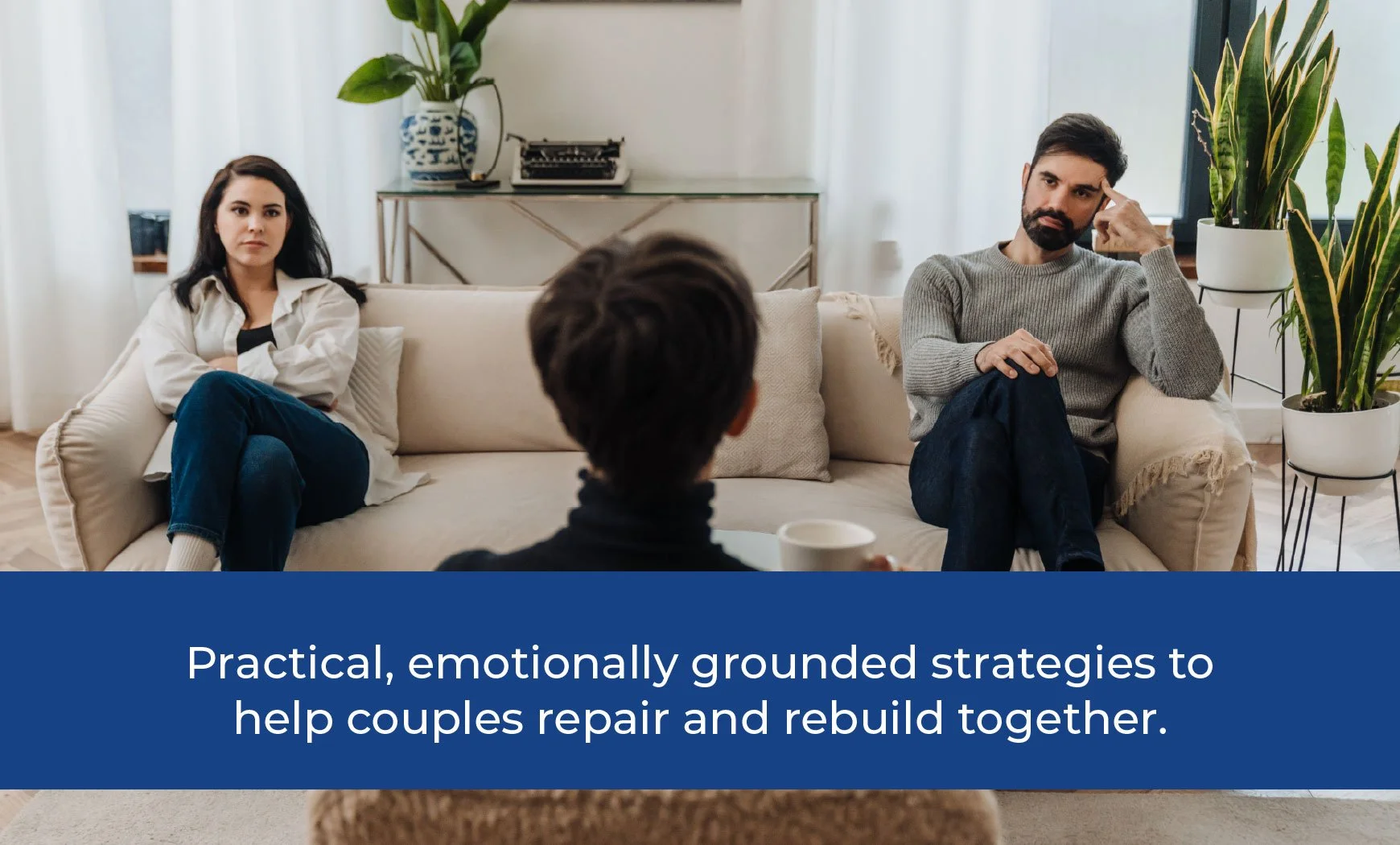
Here are practical, emotionally grounded strategies to help couples repair and rebuild together from our experienced couples counselling Calgary therapists:
Take a Pause Before Reconnecting
If emotions are intense, step away to cool down rather than pushing forward in the heat of the moment.
Example: “I need a few minutes to calm down so I can hear you better. I’m not walking away—I want to come back to this.” Taking time to emotionally regulate (for help on how to do this, check out these resources) and ground yourself before coming back leads to a greater chance for conversations to be calm and productive. It’s hard to make movement on repairing conflict when people can’t hear each other properly.Lead with Accountability, Not Excuses
Owning your part builds safety. While this takes vulnerability, displaying ownership of what you contributed to communication and conflict that did not help builds a sense of togetherness and brings the couple back to a sense of “we” rather than “me vs. me” according to our couples counselling Calgary AB therapists.
Example: “I see that raising my voice made you shut down. I’m sorry—I want to work on that. Can we talk more now in a calm way?”Validate Your Partner’s Feelings
Validation doesn’t mean agreement—it means understanding. This can go a long way in establishing common ground for moving forward. It is okay to agree to disagree while both people are aware of what happened and how they felt.
Example: “I get why that hurt; I would have felt the same” or “I can see that was really hurtful for you.”Use Compassionate Language
Tone matters. Soft starts lead to safer conversations. Even if we don’t start with a soft tone, hopefully we can shift to one as part of our repair.
Example: In a calm tone of voice, approach your partner with openness and appropriate non-verbal communication: “Can we talk about what happened? I want to understand you and your feelings better.”Share What You Were Feeling—Not in Defense, but for Clarity
Understanding the emotional underlayer helps couples connect and build back from conflict.
Example: “I wasn’t trying to ignore you—I felt overwhelmed and didn’t know how to respond.”
Offer Repair Attempts During Conflict Whenever Possible
Small gestures can defuse tension.
Example: A gentle touch, a humor cue, or saying, “This is hard. Let’s slow down.” Sometimes our couples counselling Calgary AB therapists will have couples come up with a silly word or phrase that they can say when things are getting heated to defuse the situation and signal that a break may be needed. Pick a funny phrase, word, or animal. Imagine fighting with your partner and all of a sudden they’re saying, “Fuzzy yellow duck!” While it might not bring a smile to your face in that context, it might bring you to pause and slow down a bit.Apologize Meaningfully
A real apology acknowledges impact, not just intent. Unhelpful apologies sound like, “I’m sorry, it won’t happen again” (empty promises) or, “I’m sorry” said in a frustrated or sarcastic tone (seems inauthentic) or, “Okay, I’m sorry!” (which feels forced). Our couples counselling Calgary AB therapists remind you that apologies need to be heartfelt and take real accountability for your actions.
Example: “I didn’t mean to hurt you, but I see that I did. I’m truly sorry” or, “I realize that the way I brought that up was in a poor way at a bad time and I apologize for that. Can we try again?”Make a Plan for Next Time
Repair is future-oriented and is a way for couples to learn from what happened during this conflict and helps build change for the future. Our couples counselling Calgary AB therapists encourage couples to sit down and talk through what they learned from their most recent conflicts rather than ‘fix them and move on’ as the conflict might follow you into the future. .
Example: “Next time we argue, let’s agree to take a break before things get heated.” This might also be the time where couples implement a regular relationship check-in and/or code word and/or discuss how to take that break without triggering a sense of rejection.Reaffirm Your Commitment to Each Other
Reminding your partner that you're in this together helps to strengthen trust and moves you forward together, not apart. Without repair, the individuals in a partnership can be left feeling further isolated, say our couples counselling Calgary AB therapists.
Example: “We’re on the same team. I love you, and I want us to get through this.” Bringing in gentle touch like holding a hand or touching a shoulder can offer a physical reassurance of presence and togetherness too.Rebuild Connection After Repair
Repair ends with reconnection—emotional, physical, or both. This can feel very heartening and encouraging for the partners, observe our couples counselling Calgary AB therapists.
Example: A hug, shared activity, or saying, “Thank you for working through this with me” (make-up sex can work too, so long as there was repair and learning that occurred and is not just being used to avoid the issue and build a false sense of intimacy).
Relationships Require Ongoing Work and Investment Say Our Couples Counselling Calgary AB Therapists
Repair is not a one-time tool—it’s a lifelong practice. Healthy relationships aren’t built from avoiding conflict but from approaching conflict with compassion, honesty, and teamwork. Rebuilding after a rupture is where trust grows deepest.
Every apology, every moment of reflection, every shared effort to reconnect becomes part of the fabric that holds a relationship together.
Looking to keep improving your relationships? Here are a few resources to support you:
Codependency and Relationship Resource Suggestions (including free downloadables)
The Steps of Emotion Focused Therapy for Couples
Looking for couples or individual relationship counselling? Our experienced therapists at Sana Psychological would be happy to help you with your relationships goals with a variety of evidence-based, supportive therapeutic techniques to help you. Visit our online booking page for therapist bios and availability anytime.